Connection Basics

Diagnose Fatigue-Induced Failure in Cables in Motion

A major concern in robotics applications, cables in motion experience fatigue that can cause failures whether or not that motion is constant. Cable and harness test systems can help identify the source.   Cables in motion experience fatigue that can cause complete or intermittent failures, whether or not that motion is constant. Cable and harnessRead More

How to Specify High-Speed Mezzanine Connectors

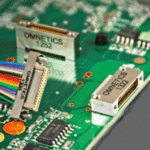
High-speed signal integrity concerns make choosing a connector for mezzanine board-to-board applications even more complex. Julian Ferry of Samtec offers advice on how to specify high-speed mezzanine connectors.   Choosing a connector for mezzanine board-to-board applications presents specification challenges in several engineering disciplines. High-speed signal integrity concerns make the selection even more complex. What is aRead More

Managing Connector Design Changes

Any change to a connector design can cause undesirable and unanticipated results. In order to manage the risks associated with design changes, a well-established and effective process is required.   There are many possible motivations for changing the design of a connector. Typically these would include: Need for enhanced performance by a specific customer or theRead More

Safe Fiber Optic Splicing Techniques

Cable splices are a necessary evil in designing and installing a communications network, particularly in an industrial setting, so let’s take a look at safe fiber optic splicing techniques.     In a perfect world, a fiber optic installation would consist of long, continuous cable runs from one destination to another. However, in the realRead More

How to Specify Water-Resistant Fiber Optic Cable

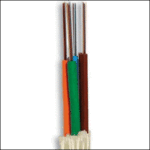
Installing fiber optic networks in harsh environments, such as on the factory floor, requires special considerations. Here, Berk-Tek explains how to specify water-resistant fiber optic cable for demanding applications.   Fiber optic cables have become an integral part of applications such as data centers, local area networks, telecom networks, industrial Ethernet, and wireless. Each applicationRead More

Five Things to Know About Pre-Terminated Cabling and Network Deployment

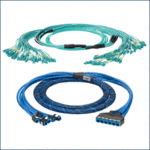
How do pre-terminated optical fiber and category-rated copper cabling stack up against field-terminated versions? Leviton shares five things to know about pre-terminated cabling and network deployment.   Pre-terminated cable provides a plug-and-play solution for links between switches, servers, patch panels, and zone distribution areas in the data center. These solutions include a variety of trunkRead More

Single-Mode Connector Attenuation Estimation

In the latest installment of our “Connector Basics” series, Randy Manning of APEX explains basic single-mode connector attenuation estimation using Monte Carlo simulation.    An optical fiber connector is a mechanical component that transfers light between two fibers or between a fiber and an active device such as a transmitter or receiver. A connector isRead More

How to Successfully Launch a New Connector Product

In our continuing series on connector basics, Bill Garver of APEX Electrical Interconnection Consultants examines the final step of the connector development process: How to successfully launch a new connector product.   In a previous “Connector Basics” article, we discussed how manufacturers must optimize the talents of their employees so that critical needs are addressed to ensure a successfulRead More

Five Connector Specs to Combat Environmental Issues

There are simple ways to customize a connector’s performance to better withstand harsh environments. Remke examines the five connector specs that combat environmental issues.   When establishing electrical connections in harsh environments, standard cable connectors and assemblies often don’t cut it. There are simple ways, however, to customize any connector’s performance. Common environmental issues for connectorsRead More

How to Specify M-Style Sensor Connectors

M-style connectors come in various forms and sizes. Binder explains how to specify M-style connectors and the benefits of using an industry-standard connector.   M-style connectors are a standard connecting solution for sensors and actuators in industrial network applications. They are designed to withstand harsh environments while providing reliable data and power transmission to automated machinery.Read More

How to Specify Industrial Fiber Optic Cable

Ensure optimal performance in demanding environments with these tips on how to specify industrial fiber optic cable from Kyle Mrkva of Belden.   Fiber optic cabling is applicable in any industrial environment where high-speed, high-bandwidth data solutions are needed. It can be used for campus and in-building data backbones to anchor an operation’s Ethernet, andRead More

How Connectors Lower Wiring Costs

The assumption that hardwiring will minimize wire installation costs is wrong. Here, Lapp Group explains how connectors lower wiring costs. If you design or build industrial machines, you probably know all about hardwiring. It remains the most common way to bring power and signal to the machine because it offers a perceived savings in installationRead More

2026 World Connector Market Handbook 2025-2031F
x