Connection Basics

A Custom Solution for Tight Spaces – Micro and Nano Cables

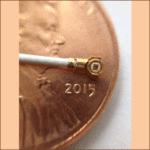
Shielded micro- and nano-sized cables save space and weight in portable electronics. By Bob Stanton, Omnetics Connector Corporation Design teams are constantly demanding higher density connections to increase the functionality of each part of their instruments. The problem is, the amount of space available for the internal wiring systems required to route signals from oneRead More

Derating Wire Harnesses Can Achieve Weight, Space, and Heat Goals

Designers can use derating to capture the advantages of lighter-weight wires without sacrificing performance. By Michael Traskos, EWIS Designated Engineering Representative (DER) and President, Lectromec   By derating wire harnesses, designers can expand their options to choose materials that can perform in a greater range of applications and environments. The temperature rating of a wireRead More

Five High-Frequency Connector Fundamentals

Five AC conditions affect high-frequency connector contact and performance. By Roland S. Timsit, PhD, PE, Timron Advanced Connector Technologies   Many performance attributes of electrical connectors, such as low contact resistance, maximum current, operating temperature, and others, are often described in relation to DC conditions. Under AC conditions, and particularly at frequencies exceeding hundreds ofRead More

UL Certification Roadmap Helps Unlock Global Opportunities

Expanding the application of your connector products for global markets doesn’t have to be complex. This roadmap of UL certification considerations will help you simplify the process. By Son Do, Staff Engineer, and Chuck Kurten, Primary Designated Engineer, UL   At first glance, navigating the vast connector market can be intimidating. With hundreds of differentRead More

Design Issues in High Frequency Connectors

Engineering guidelines that have evolved for the design of electronic connectors over the years are based primarily on the current carrying capacity of the connector and achieving an acceptably small electrical contact resistance. These design guidelines cover key issues of optimal contact force, the selection of appropriate contact materials and surface finish to minimize mechanicalRead More

Seven Essentials for Rugged Connectors in IoT

The use of measuring devices to monitor and control processes is critical to the smooth operation of large systems, and it is an integral part of the future of the Internet of Things. Considerations include fiber optics, IP ratings, connector materials, and more.   Seven Essentials for Rugged Connectors in Instrumentation Applications The use ofRead More

In Search of Standards: A Look at the iNEMI Connector Reliability Test Recommendations Project

A survey of industry experts underscores the need to develop standard reliability testing protocols for connectors.   Consistently testing the reliability of electrical connectors across types and use cases is a major challenge in the connector industry. Electrical connectors come in many shapes and sizes, and differ in use. In general, the purpose of anRead More

Tribology and the Effects of Motion in Connectors

Tribology is the study of the science and engineering of interacting surfaces that are in relative motion, and includes the associated principles of friction, lubrication, and wear. So how does tribology relate to connector interfaces?   Although connector contact surfaces are usually not intended to be in continual relative motion, often the surfaces do experienceRead More

The Rugged Connector Checklist

Rugged connectors are required for applications in a wide variety of settings, from sterile medical facilities to downhole oil and gas rigs. Key considerations for specification include the environment, the function, and the performance requirements.   Rugged Connector Checklist Rugged connectors must be able to function in environments and under circumstances that would challenge typicalRead More

Corrosion Considerations in Connector Development

Learn more about the technical guidelines that drive connector development for corrosive environments to ensure a long-lasting and reliable solution in harsh conditions.   Corrosion Considerations in Connector Development Corrosion is a process known to everyone who owns a car. In essence, rust is the corroded product of iron: Iron atoms slowly detach from theRead More

Extreme Materials: Robust Performance from Cable to Connector

From specifying the correct stranding configuration to creating specialty extreme material blends to ensure optimal jacket performance, selecting the right combination of variables plays a critical role in the success of products.   In all environments, especially extreme conditions, high reliability and zero downtime are imperative; even the smallest factor can be the difference betweenRead More

Design Considerations When Terminating Aluminum Wire

It may be necessary to replace copper wiring with aluminum in automotive applications to reduce vehicle weight and achieve the aggressive future fuel-economy standards, but design engineers must be mindful of the significant differences between aluminum and copper wire terminations.   Aluminum wiring has been used for many years in several different industries. Utility companies have successfullyRead More

2026 World Connector Market Handbook 2025-2031F
x