Learning Tools Articles

How to Specify Aluminum Wire for Automotive Applications

Restrictive connector terminal solutions can be an issue when specifying aluminum wires for automotive applications.   In light of time-to-market issues in the automotive industry, aluminum is the best option for reducing the weight of the electrical distribution system and harnesses. Aluminum has been used in battery and power applications in premium cars for some time.Read More
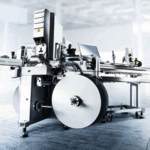
Five Things to Know About Automatic Crimping Machines

When every penny counts, manufacturers look to wire processing equipment suppliers to help cut production costs and improve the cost per lead. To assist in your next equipment purchase, Komax offers five things to know about automatic crimping machines.   In today’s competitive business environment, wire harness manufacturers are winning contracts by the penny. WhenRead More

How to Specify Electrical Insulating Material

Choosing the right material combinations for a specific application can mean the difference between success and failure. Richard Orstad of Fralock presents a primer on how to specify electrical insulating material.   There are hundreds of decisions required when designing mission-critical electromechanical components. In each of these decisions, choosing the right material combinations for a specificRead More

How to Successfully Launch a New Connector Product

In our continuing series on connector basics, Bill Garver of APEX Electrical Interconnection Consultants examines the final step of the connector development process: How to successfully launch a new connector product.   In a previous “Connector Basics” article, we discussed how manufacturers must optimize the talents of their employees so that critical needs are addressed to ensure a successfulRead More

How to Specify M-Style Sensor Connectors

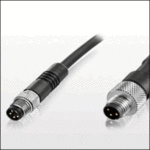
M-style connectors come in various forms and sizes. Binder explains how to specify M-style connectors and the benefits of using an industry-standard connector.   M-style connectors are a standard connecting solution for sensors and actuators in industrial network applications. They are designed to withstand harsh environments while providing reliable data and power transmission to automated machinery.Read More

How Connectors Lower Wiring Costs

The assumption that hardwiring will minimize wire installation costs is wrong. Here, Lapp Group explains how connectors lower wiring costs. If you design or build industrial machines, you probably know all about hardwiring. It remains the most common way to bring power and signal to the machine because it offers a perceived savings in installationRead More

How to Specify Rectangular Connectors for Automotive Applications

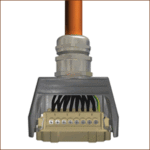
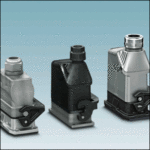
Rectangular connectors are commonly used in automotive applications, but the industry has unique requirements. Phoenix Contact offers tips on how to specify rectangular connectors for automotive applications. Rectangular connectors have long been used in industries where a harsh environment is standard operating procedure. These connectors need to meet a variety of specifications, including a high IngressRead More

Nanocrystalline Silver Alloy Contact Finishes in Electronic Applications

Dr. Bob reviews two recently published papers to draw conclusions on the possible use of nanocrystalline silver alloy contact finishes in electronic applications. In my previous article, in which I mentioned two recent papers* on the nanocrystalline silver alloys of silver-tungsten (AgW) and silver-palladium (AgPd) and their use as contact finishes, I highlighted the potential benefits these alloysRead More

The Importance of Contact/Housing Retention

Never underestimate the importance of contact/housing retention mechanisms. Serious issues can arise if contacts are not assembled properly or if the retention device is not robust.   Connectors retain their electrical contacts within an insulating housing. Some retention mechanisms are more reliable than others. Serious issues can arise if the contacts are not assembled properlyRead More

Computer Tomography for Development and Process Optimization

Three-dimensional digital models of components created with the help of a computer tomograph enable targeted process optimization of injection molding and high-pressure die-casting processes.   Computer tomography is an X-ray-based procedure in which the test object is scanned from different angles. The test object is positioned on a turntable between an X-ray source and aRead More

How to Use USB 3.0 Connectors

As we begin to expand usage of USB 3.0 to reap the many benefits, we must pay attention to how the connectors and cables affect circuit operation. Here, Omnetics’ Bob Stanton explains how to use USB 3.0 connectors and cables.   As we begin to tap into the potential of USB 3.0 speeds that run upRead More

How to Specify Connectors for Drones

Erich Reichenbach of Reichenbach International Inc. offers tips on how to specify connectors for drones, which require versatile, lightweight, and reliable components that perform in demanding environments.   Connectors for drone applications must be small, lightweight, rugged, reliable, and versatile, as they are exposed to a variety of demanding environments. Here are some factors to consider when specifyingRead More

2026 World Connector Market Handbook 2025-2031F
x