Posts

Rectangular Connectors for Mil/Aero Disconnect Applications

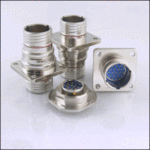
While circular connectors are often the go-to choice for mil/aero applications, rectangular connectors may be an alternative under certain conditions.   Circular connectors have been a mainstay in the military/aerospace market segment for more than 75 years, but there is another option for your disconnect application. Governed primarily by the MIL-DTL-5015 and MIL-DTL-38999 specifications, circularRead More

Single-Mode Connector Attenuation Estimation

In the latest installment of our “Connector Basics” series, Randy Manning of APEX explains basic single-mode connector attenuation estimation using Monte Carlo simulation.    An optical fiber connector is a mechanical component that transfers light between two fibers or between a fiber and an active device such as a transmitter or receiver. A connector isRead More

Distance Makes a Difference: Fiber Optics or Copper?

Choosing between fiber optics and copper? According to Jacques Mieville of Fischer Connectors, the further you go, the more you need fiber.   When properly maintained, there is no argument that fiber has significantly greater bandwidth and is more reliable than copper. Because fiber transmits data as a series of light pulses instead of electricalRead More

How to Specify Small Form Factor Optical Connectors

Over the last three decades, a myriad of optical connectors have come and gone, but small form factor connectors are making the choice easier these days. Molex offers tips on how to specify small form factor optical connectors.    In a maturing market, there are clear winners that prove superior and push out competing technologies.Read More

Five Things to Know About OFC 2015

The annual Optical Fiber Communications Conference continues to grow, and ProLab’s Giacomo Losio reports on the top five technologies that everyone was talking about.   OFC 2015 was a very busy show. Sometimes you go to a two-day event and think it could have been condensed into one, but in OFC’s case it could have been three andRead More

How to Specify Aluminum Wire for Automotive Applications

Restrictive connector terminal solutions can be an issue when specifying aluminum wires for automotive applications.   In light of time-to-market issues in the automotive industry, aluminum is the best option for reducing the weight of the electrical distribution system and harnesses. Aluminum has been used in battery and power applications in premium cars for some time.Read More

Gaining Net Value to the Automotive Supply Chain

While secondary sourcing can be a viable option to mitigate supply chain interruptions, many connectors for today’s automobiles are so specialized that finding a second source can mean a whole new set of challenges. The “supply chain” is the process by which a company creates and distributes its products and services to the end users. The execution begins whenRead More

Five Things to Know About Automatic Crimping Machines

When every penny counts, manufacturers look to wire processing equipment suppliers to help cut production costs and improve the cost per lead. To assist in your next equipment purchase, Komax offers five things to know about automatic crimping machines.   In today’s competitive business environment, wire harness manufacturers are winning contracts by the penny. WhenRead More

Improve Crimp Quality to Increase Productivity

Poor crimps can slow down a production line. Schleuniger explains how to improve crimp quality to increase productivity.   A high quality crimp termination will usually exceed the service life of the product in which it is installed. On the other hand, a marginal quality crimp termination can cause electrical failures early in a product’sRead More

Heavy-Duty Terminals for Automotive Applications

Electric terminal manufacturers utilize a good portion of their engineering resources to develop new products or improve existing terminals for the automotive industry. Sam Francois of ETCO examines the keys to choosing heavy-duty terminals for automotive applications.   Problems within a vehicle’s electrical system have long plagued the automotive industry. One of the most common areas forRead More

Copper or Fiber in Commercial Aircraft?

Which is the better option – copper of fiber – in commercial aircraft? Earle Olson of TE Connectivity discusses the benefits of fiber in today’s increasingly sophisticated commercial airplanes.   Commercial aircraft run on information. As aircraft designers embrace the concept of MEA (more electric aircraft) to replace mechanical control systems, embedded computers are evolving to handle increasedRead More

How to Specify Electrical Insulating Material

Choosing the right material combinations for a specific application can mean the difference between success and failure. Richard Orstad of Fralock presents a primer on how to specify electrical insulating material.   There are hundreds of decisions required when designing mission-critical electromechanical components. In each of these decisions, choosing the right material combinations for a specificRead More

2026 World Connector Market Handbook 2025-2031F
x